News
NEWSLETTER SIGN UP

At O&T Farms, we use the term “dry extrusion” when describing how our value-add linPRO products are manufactured; but what does the term really mean? Simply put, extrusion is a process in which material is pushed through a small opening; however, it’s important to know that not all extrusion processing is the same. O&T Farms patented dry extrusion process helps increase the functional usage of raw ingredients while also providing added availability of nutrients to the livestock.
1. Defining Dry Extrusion:
Dry extrusion is a unique form of extrusion processing in that no external heat source is used during the cooking of the product. Instead, dry extrusion relies solely on the heat generated from the friction of the material as it passes through the barrel by a screw. A common misconception of the term “dry extrusion” is that the process occurs in the absence of moisture; however, moisture of the raw ingredients entering the dry extruders may range from 8-22% and can be modified through pre-conditioning processes. In contrast, “wet extrusion” processes may apply an external heat source directly into the barrel during cooking (e.g. steam).
2. Impact on Nutritional Value of Feed
Proteins:
During the cooking-phase of dry extrusion processing, the proteins of the raw ingredients begin to denature. The approach applied by O&T Farms ensures temperatures reach the necessary level to break the secondary bonds of protein molecules releasing individual amino acids and improving their availability for digestion by the animal. The process reduces the solubility of the protein which is of special significance for ruminant livestock as it improves the level of rumen undegradable protein (RUP) while ensuring the digestibility of the amino acids in the lower GI-tract.
Starch:
Starch represents a significant portion of the total energy value of any feed ingredient and gelatinized starch is much more efficient for the animal to digest. As raw feed ingredients pass from the extruder barrel and are pushed through the narrow die opening of the extruder unit, the sudden release of pressure facilitates expansion. This expansion process ruptures the starch cell walls, vaporizes moisture and opens the starch molecule up making it more accessible to digestive enzymes.
Fat:
Fat from flaxseed is the not-so-secret ingredient in LinPRO products and offers an important value-add opportunity for the North American oilseed industry since whole oilseeds are difficult for livestock to digest and utilize efficiently. Milling of flaxseed has been applied for livestock feed but only partially disrupts the durable seed-coats and increases the risk of fatty acid oxidation.
Under the O&T Farms patented dry extrusion process, carefully calibrated conditions are applied to improve the nutrient availability of the oils in flaxseed while also improving the overall stability and shelf-life of the product. By matching the flaxseed with a specific starch source and combining them through their processing parameters, the formation of lipid-starch complexes can be facilitated which makes the finished product less soluble and more stable. It is this reaction that necessitates the use of acid hydrolysis analysis when determining the fat content of an extruded product, since some of the fat will not be soluble in the commonly used ether extract methods. This reaction also has particular implications for dairy cattle as it can help reduce the risk of milk-fat depression and impaired fibre digestibility by reducing lipolysis and subsequent biohydrogenation of unsaturated fats within the rumen.
Anti-nutritional Factors:
Many feed ingredients contain compounds known as anti-nutritional factors which reduce the efficiency of nutrient utilization by the animal. Dry extrusion processing has consistently demonstrated an ability to reduce and inactivate commercially-significant anti-nutritional factors such as urease and trypsin inhibitor. By reducing the presence of these compounds in the feed, livestock can use the nutrients more efficiently which increases the overall nutritional value of the product.
Feed Safety:
More than ever, feed safety is top-of-mind for livestock producers and feed manufacturers. The cooking process through dry extrusion is an excellent strategy for reducing the microbial-load of feed ingredients and minimizing the risk of feed contamination.
3. The Take-away
Extrusion is an efficient technology that is used to breakdown raw ingredients into a homogenized, cooked, easily digestibly and stable product. However, not all extruded products are the same in that the application of this technology is highly variable throughout the feed manufacturing industry resulting in different physical quality and nutritional characteristics of the end product. O&T Farms applies a unique and well defined patented dry extrusion method in the manufacturing of their LinPRO products through carefully calculated processing conditions to optimize nutritional value of the finished livestock feed ingredient.
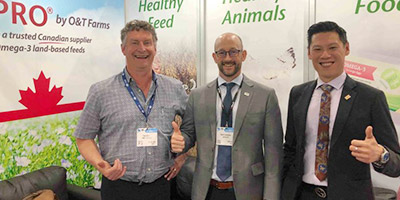
O&T Farms brought linPRO, its dry-extruded land-based Omega-3 animal feed ingredient to the 2019 VIV Asia Trade Conference held at the BITEC from March 13-15, 2019 in Bangkok, Thailand. The show attracted more than 45,000 professional visits, confirming this to be the largest feed show in Asia.
Of the 45,000 vists made to the 2019 VIV Asia trade show, it was confirmed that 65% came from outside of Thailand, confirming the International presence. This exhibition is a critical show for the Asian market and O&T Farms was pleased to meet so many great guests and associates. The top 10 countries visitors as established by the VIV Asia exhibition data were; China, India, Philippines, Vietnam, Indonesia, Malaysia, Bangladesh, Korea, Taiwan and Pakistan.
O&T Farms was profesionally represented by its associates from BMC , NutriSpices and Anscitech at the 2019 VIV Asia show. Many thanks to the support that was also received from STEP, helping with our coordiantion of the trade show and allowing us to be a part of Team Canada ?? ! We look forard to seeing you again in Bangkok for 2021 VIV Asia.
O&T Farms with guests at 2019 VIV Asia
Meeting with our associates from Thailand. Great Questions on Omega-3’s!
January 2019

With increasing global restrictions on antimicrobials, increased demand for poultry products and a shift in consumer preferences, the poultry industry must adapt to a rapidly changing world.
The growing scientific field of nutrigenomics offers applied solutions to these challenges through identified links between nutrition, health and genetic expression in the birds; thereby offering producers holistic solutions in a world of limiting resources and growing demand.
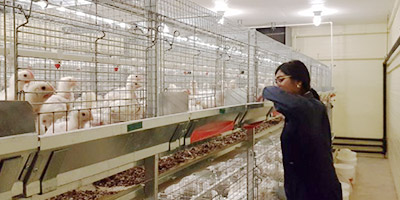
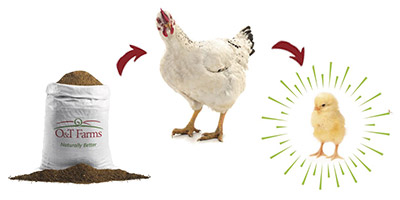
Omega-3 fatty acids have gained attention recently for their potential nutrigenomic applications in breeder birds towards improved reproductive performance and the development of robust offspring. Although often used in layer and broiler diets to produce value-add food products (eg. Eggs), Omega-3 fatty acids are not commonly incorporated in the diet of breeder stock. Turns out, these birds could be missing out on some key benefits, and so could their chicks. Omega-3 fatty acids are well known for their ability to modulate inflammatory responses; a response which may be passed on to the offspring through an epigenetic response. Furthermore, omega-3 fatty acids have been shown to exhibit reproductive benefits in females and males of various species, suggesting potential production benefits at the breeder level.
Dr. Elijah Kiarie (University of Guelph) is currently investigating the potential link between omega-3 in the breeder bird diets and the success of the offspring. Through an ambitious research initiative, he aims to identify the effects of feeding linPRO, as a source of dietary omega-3 fatty acids, to broiler and layer breeders on: reproductive efficiency of the breeders, embryonic survival and hatchability, progeny robustness including health, performance, livability, carcass quality, gut health and bone health (the opportunity). Preliminary information on the digestibility of linPRO for breeder stock was presented last year at the 2018 IPPE Conference (Atlanta, GA) and the PSA Meetings (Houston Texas), reporting impressive energy availability and nutrient digestibility data from this specialty feed. Since then, the omega-3 feeding programs have continued with both breeder and progeny evaluations underway, and expected to be complete by early summer 2019. Dr. Kiarie is confident that the exciting new data collected over this past year will be accepted for presentation at the 2019 PSA Meetings, to be held in Montréal, Québec.
The poultry industry shift towards applications of nutrigenomics is on-going, ensuring the health of the birds and sustainability of the industry. Scientific collaborations are enabling a deeper understanding of the important relationship between animal nutrition, health and performance. Thanks to continued research efforts, such as the omega-3 initiative of Dr. Kiarie and The University of Guelph, the poultry industry can replenish their toolbox when resources are limiting and maintain consumer support for the products they produce.

Top Crop Article
Research shows you can get those healthy Omega-3 fatty acids not only from eating ground flaxseed and flaxseed oil, but also from the eggs, meat and milk of flaxseed-fed poultry, swine and cattle. Perhaps, then, it’s no surprise the Canadian flax industry is working to enhance and expand Omega-3 opportunities with flaxseed feed and focusing on how flaxseed feed’s many healthy attributes can benefit animals, livestock producers and feed processors while expanding the flaxseed feed market for growers.
Dairy producers are turning to the omega-3 feed ingredient called linPRO-R as a strategy to optimize the health and performance of their cattle herd. LinPRO-R feed ingredient is gaining attention for its associated omega-3 benefits on animal health and reproductive performance.
Dr. Troy L. Ott, Professor of Reproductive Physiology at Penn State University, offered this comment on their current research with linPRO-R: “ongoing research at Penn State supports the hypothesis that feeding a diet enriched in omega-3 fatty acids (linPRO-R) from calving to 21 days after calving alters immune cell function in transition dairy cows”. Furthermore, commercial application has shown an improvement in dairy cow conception rates as high as 20% in some herds when linPRO-R was included in the diet.
For more information on these exciting data, check-out the O&T Farms feature article in the September 2016 issue of American Dairymen.
View the full American Dairymen article by clicking HERE.
The Spring 2016 issue of the University of Saskatchewan’s agknowledge magazine features an article on the accomplishments of our colleague Janna Moats (pg 22). Janna pursued her graduate studies in ruminant nutrition at the University of Saskatchewan and successfully defended her thesis. Collaborating with several parties, Janna has effectively communicated the Omega-3 opportunities for functional foods like milk and cheese.
Got milk? The farm-to-fork connection…pg 22 U of S agknowledge

The Lacombe Research Station ~ Alberta Canada
Mike Dugan PhD of Agriculture Canada’s Lacombe Research Centre discusses research being conducted on the economic value of beef fat. Lacombe is trying to enrich the Omega-3 fatty acids of beef as well as increase the biohydrogenation production. Lacombe is using linPRO-R for this research, with O&T Farms being a partner in the research. linPRO-R is a dry-extruded specialty feed produced specifically for ruminant applications.
See Western Producer URL link: https://www.producer.com/2015/09/researchers-add-value-to-beef-fat/

Janna Moats ~ August 2015 American Dairyman
In the August 2015 issue of American Dairyman on page 33, Janna Moats discusses her findings on using extruded flaxseed (linPRO-R) to create an Omega-3 profile in milk. Janna goes on to say that feeding linPRO-R to dairy cattle can improve the health of the animal while simultaneously improving the nutritional value of the milk for consumers. The article discusses the relevant opportunity of developing healthier dairy products that carry an enhanced Omega-3 profile. Janna’s Omega-3 dairy data from her research thesis at the University of Saskatchewan is part of a collaborative effort between several parties. Of special note is the supervisory work provided to Janna by Dr. David Christensen and Dr. Timothy Mutsvangwa, both of the University of Saskatchewan.
While the Omega-3 profile carries such a recognized health benefit at the consumer level, another important facet pointed out by Janna was the three-fold increase in conjugated linoleum acid (CLA).
O&T Farms provides information on Omega-3 cattle, poultry and swine feed.
Meat Business Magazine April 2014 ~ page 22 discusses the Omega-3 market
Tim Wiens, the President and owner of O&T Farms speaks with Meat Business about the consumer awareness of Omega-3’s in the functional food market. Consumers are looking for healthier functional food’s and are willing to pay for those products. Omega-3 eggs, meats and dairy products are a part of the functional food extension of healthier products and O&T Farm’s specialty feed called linPRO helps to support this initiative. Using a blend of flaxseed and pulses processed through dry extrusion, O&T Farms has created a highly digestible and palatable specialty feed ingredient for livestock. It starts with what we feed our livestock.
October 2013
New research from Nielsen and O&T Farms supports demand for Omega-3 chicken
Chicago, Ill. (October 15, 2013) – Consumer research from the Nielsen Perishables Group, the industry expert in fresh food consulting, and O&T Farms, a leading animal nutrition innovator, found 79 percent of consumers polled are interested in chicken enriched with Omega-3 fatty acids, and 58 percent of those consumers would pay a premium for it.
Best known for their presence in fresh fish, Omega-3s are believed to promote heart health, improve prenatal health, and reduce inflammation, cognitive aging and developmental disorders. A new chicken nutrition offering from O&T Farms enables the popular health attribute to expand from the seafood department into the meat case. Omega-3 chicken is powered by linPRO, which uses an all-natural blend of flaxseed and pulses in a patented dry-extrusion process to produce a digestible and nutritious chicken feed ingredient.
The national survey of 700 chicken consumers found that while value and taste are the top attributes for consumers’ food and beverage purchases, nutrition and health play a significant role. Specifically for chicken, research respondents rated omega-3 behind only antibiotic-free and hormone-free chicken on their list of top production-oriented attributes.
“We expected to find that consumers are receptive to a new health attribute in the meat case, but we were surprised to see such a high percentage who are willing to pay a premium for the Omega-3 chicken,” said Sherry Frey, vice president, Nielsen Perishables Group. “Consumers are prioritizing their health now more than ever.”
Interest in Omega-3 enriched chicken is highest among consumers who shop in natural/specialty food stores, where 93 percent indicated they are interested in the product, and 80 percent of those consumers are willing to pay a premium. Appeal is also high among consumers over age 35.
Optimal messaging will be critical to Omega-3 chicken’s appeal on shelf. The research indicates consumers prefer simple messaging that clearly explains the health benefits of Omega-3 chicken.
About Nielsen Perishables Group
As a vital part of Nielsen, a leading global provider of information and analytics around what consumers watch and buy, Nielsen Perishables Group provides a holistic picture of store-level activity across retail channels. Based in Chicago, the company offers a full spectrum of products and services geared toward complete fresh food market and category understanding. Solutions include retail measurement, research, analytics, marketing communications, category development, promotional best practices and shopper insights. For more information, visit www.perishablesgroup.com.
Notable News Sources
Perishable News
http://www.perishablenews.com/index.php?article=0032354
Global Meat News
http://www.globalmeatnews.com/Industry-Markets/Omega-3-chicken-could-command-a-premium-finds-US-study
CONTACT:
Kelli Beckel,
773.929.7013,
kelli.beckel@nielsen.com
Global Meat News posted an article discussing the important findings of our recent work with Nielsen Perishables investigating consumer interest in Omega-3 chicken.
Read the full story here: globalmeatnews.com